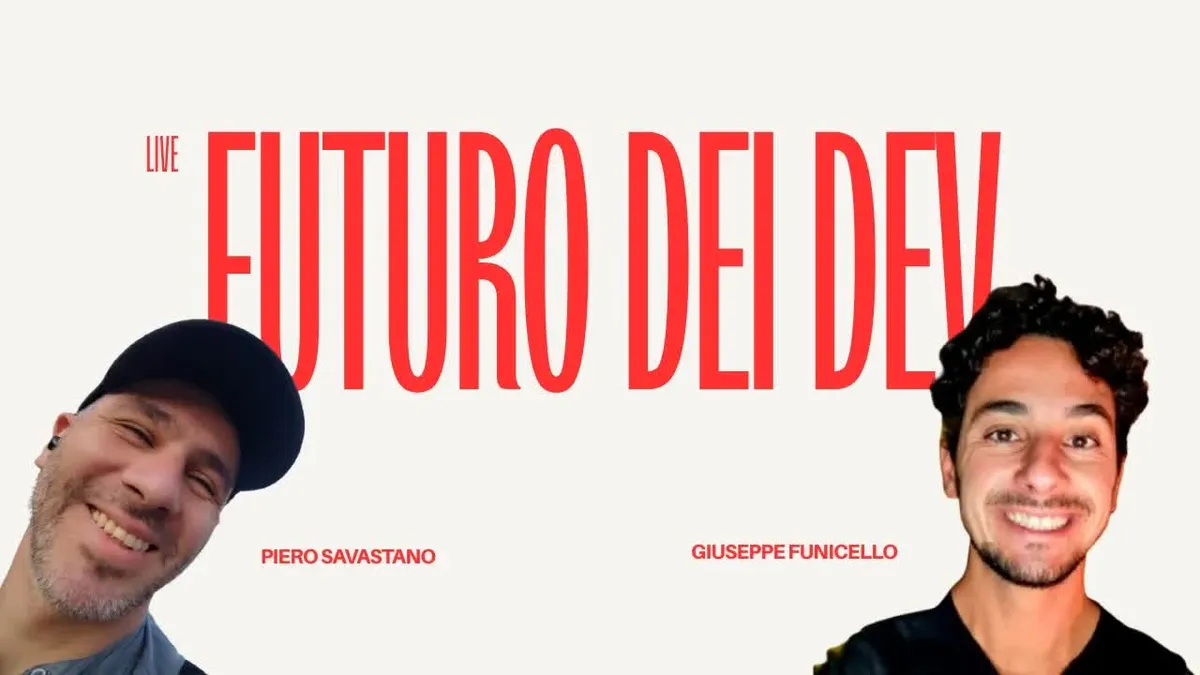

This one is a live conversation with Giuseppe Funicello - a developer and fellow YouTuber I follow closely. We’d been bouncing ideas off each other about the same anxiety, and decided to have it out loud: is it still worth learning frameworks, writing code, and building digital products? What is our future, and does any of the old craft still pay off?
Here’s the discussion, cleaned up and organized.
Giuseppe: from freelance to building his own things
Giuseppe spent years as a freelance developer - for him it was almost a mission: work for himself, travel, experiment. About a year and a half ago, even with a good balance, freelancing started to wear thin. He wanted more independence and the courage to try projects of his own. For the last month and a half he’s been fully on his own stuff: a pile of experiments, several things in the pipeline, and none of them with an obvious business model yet.
One project I loved is Informatici di Quartiere - “neighborhood IT people.” The idea is simple. In our communities we’re always talking to each other about models - now there’s Fable, no, Opus, no, GPT - while his sister is asking some ChatGPT clone what to do with her life, and kids in high school study computer science without ever touching anything real. So instead of just building online community and talking among ourselves, why not bring people who are comfortable online down to the actual neighborhood: meet people, talk about technology, run experiments, tell the story on YouTube. It’s messy, but they’re trying.
Pensarium, and the doubt that comes with it
On the technology side, Giuseppe built Pensarium, a journaling app. His advice, which I fully endorse: if you want to really get your hands dirty, build a real product, not experiments that sit in a drawer. A finished product forces you to solve everything.
Giuseppe likes journaling, but he doesn’t like talking to an AI and getting answers back. He wanted a tool that uses AI only to support the writing. He rebuilt it five or six times, tried a thousand frameworks - local, then mobile, then web - and in the process learned how memory actually works at a lower level: how to take the text you write and extract a memory that genuinely makes sense. He’d started from a RAG, but RAG only gave him one kind of output; he wanted relationships and connections, so he went off and experimented.
And here’s the doubt, the one that kicked off the whole conversation: does it even make sense to build this? Anyone can spin up an artifact on Claude, keep it there, and be perfectly happy - because most people don’t care that much about privacy or polish. So is it still worth building sweated-over digital products if an agent can recreate them in minutes?
I brought the same experience from the other side. My open-source project, the Cheshire Cat, is a framework rather than a product - but the lesson is parallel. This stuff moves so fast that the AI-related offering itself grows and changes so quickly that anything you build is old in three months, even when you’re riding the crest of the wave and among the first in Italy to do it. The whole of computing feels like it’s shifting under us. Why craft artifacts by hand if an agent can regenerate them? This is the era of disposable code - code made for the meme, apps built on the spot.
Two agents in parallel
On tooling, Giuseppe experimented with running Claude Code and Codex side by side. Not just to save money, but because having two models let him do a lot of planning in between them: plan with one agent, talk to the other, not by copy-pasting the whole context around, but treating them like two different developers and having them challenge each other. Putting one in difficulty with the other exposed each one’s limits. He’d assumed Opus was better at certain things; instead GPT reasoned better on some, while high-level reasoning went better with Opus. Standing in the middle really fired up his brain - and he was always the one orchestrating the dialogue, always pushing them to their limit, because that’s where his value sits.
The other move: splitting the problem and delegating. Do one part with an expensive frontier model, then break the work up and hand pieces to smaller, cheaper models. With frontier models going consumption-based, that’s a pattern worth leaning on more and more.
My own setup: Claude Code as the subscription, plus consumption-based alternatives through OpenRouter. I keep testing Chinese models because I want to catch the moment a big Chinese model reaches Opus parity - the day I find it, I drop Claude entirely. Not there yet.
Funny detail we both noticed: asking multiple models for their opinion feels like holding a town-hall meeting. In reality we’re alone in a little room, talking to the AI.
The moat is leaving the software
Then the big theme: is software-as-a-service dying? I think there’s a clean way to read what’s happening. The moat - what lets you defend a digital initiative - is less and less about software. The bottleneck used to be writing software: it took time and skill. That’s still true, but far less than before. The bottleneck doesn’t die, it moves - and as the constraint moves, so does what gets paid for and what has value.
So what might carry much more value soon?
- Knowing how to gather people into a real community.
- Knowing which software to build, and how to promote and design it.
- Everything that isn’t technical: design and distribution.
- A cultural and artistic dimension that’s been missing - inside the fear there’s a chance to reinvent something deeper.
We live in a bubble
An important caveat we kept returning to: we live in a bubble. We tell each other you build everything yourself, you make an artifact - but Giuseppe’s sister, who helps test Pensarium, told him the link was too inconvenient because she keeps losing it: “you have to make me an app.” The exact opposite of what we’d do. Most people barely open an app on their phone once a day.
So maybe there’s more room than we think. Nothing is entirely dead - it depends who you’re talking to. Among tinkerers, sure, they’ll rebuild your thing the same evening from a screenshot and ask Claude to make it prettier. For regular people, the hard part is reaching them. And for companies: a big company with complicated software won’t want the hassle of self-managing it - it’ll go to a vendor.
The agentic interface belongs to Big Tech
Here’s what holds me back from going all-in on the Cheshire Cat 2. I think the agentic interface - more than the agents themselves - belongs to Big Tech. It’s like the browser: close to the user, close to the operating system. Yes, you call the language model over the cloud, but Claude Code, Claude Cowork, these apps sit right next to the user. Kids in school already have Claude installed on their desktops and just do things that way.
So I keep asking myself: do I have to build the whole stack? Is it worth it? Maybe not. Rather than an application that wraps a model, if you have real value, expose an MCP (Model Context Protocol) server and that’s enough. As one commenter put it, “MCP server is the new app” - risky, but I agree 100%. Same logic I use elsewhere: I’d rather put an app that talks over WhatsApp, because people use WhatsApp and don’t want to use your application.
Concretely, I’m already living this. My setups are built heavily out of skills plus a few personal MCP servers, and I use them extensively for my own work - gathering information I used to collect by hand, and making videos (what took three hours now takes half an hour, transcription via MCP, editing via a skill built on Remotion). I even show up to my corporate course - Reskill - with the course’s own MCP server, so teams connect their agents to it and get access to the materials interactively.
And Pensarium fits this too: beyond having its own interface and experience, its memory feature could become a module - a component plugged into one of these widespread agents.
Distribution, personalities, and data
If the product matters less, distribution moves to first place. Vincenzo Cosenza put it in the chat: “The moat is distribution.” I mostly agree - but it worries me. Remember when social media democratized publishing? Success didn’t go to the best photographer or videomaker; it went to the neomelodic Neapolitan singer filming himself. The personality won. I see the same risk: software and services that win because a personality is behind them.
But I want to believe the good ones still find their audience. What I value in Giuseppe is that he’s transparent - he doesn’t arrive with the answer ready, he says “I want to try this” and then figures it out in the open. That resonates somewhere. Communication is becoming a core skill: the soft skill that maybe was worth 5 for a developer could soon be worth 80.
The other moat is data. Why doesn’t Salesforce fall tomorrow? Because they sit on datasets - customers, suppliers, transactions, products - accumulated and curated over years. You can vibe-code all the software you want. Sure, you “vibe-coded Teams in a day” - great meme - but beyond distributing it to ten million people, show me what’s inside your Teams: which emails, which suppliers, which clients. The data stays a bulwark of defense.
There’s also a whole underserved sector in public administration - UI, UX, information architecture - where the gap is enormous, from small town councils up. I’ve met little pockets of excellence (even local language models) and, in other places, absolute zero. It’s a lottery, and it depends heavily on the level of the specific community and whether there are young people who want to innovate.
PewDiePie and memetic software
Someone mentioned PewDiePie and his project Odysseus. To me it’s the perfect example of memetic software: he documented building a local GPU cluster, put a powerful language model in his house, and then vibe-coded this thing. Do you take Odysseus as a provocation, a social initiative, a meme, or actual software? I appreciate it enormously - and I have zero intention of downloading and using it. It’s a “network of vibes”: not only vibe coding, but vibe YouTubing.
The uncomfortable question underneath: someone with no real technical skill making money through software - something we can’t do - is that a problem? I don’t know. It’s probably just a consequence of democratization.
Costs, small models, and orchestration
Fabio Biondi raised a real fear: integrating AI features while having no idea what it’ll cost in a month or a year, because prices change 3x - both longevity and not knowing what’s underneath.
My answer is to lean into smaller models. Giuseppe built part of Pensarium on Mistral Small (partly to keep everything in Europe, partly for cost). Using smaller models teaches you a lot: how do I get what I want out of a less powerful model? You don’t always need Opus. You design the application and the flows well - and, crucially, not everything has to be AI. Some parts are just regex, because that’s what the moment needed.
I’d add a pattern I find underrated: crystallize and script the flows you know are deterministic, then let the agent make the higher-level choices - the order the routines run in, the parameters. That’s easily delegated to models even in the 10-billion-parameter range; the latest small Gemma models are absurdly capable and cost almost nothing. If you want to publish AI services where you pay the API bill, you can’t have people running just-in-time Python scripts against a full filesystem. Consider the degree of automation deliberately: modularize, make programmatic the parts that don’t need to be tied to the model, and let the rest be orchestration.
The stages of the trauma
One frame I keep proposing in my scrappy little videos: read this big change as stages of trauma - really the stages of grief, but they apply here too. Denial, anger, depression, bargaining, acceptance.
Among developers, denial is starting to pass, and you can see some anger now - watch international YouTubers and some of them are genuinely furious. Others are already in the depression phase. But it passes. What we learned comes back in the form of knowing what’s under the hood, which is enormously useful. We abstract up a level, build modular software, design the modules ourselves - we become a bit more architect, a bit more designer, a bit more product. Those are useful skills. What we’ll need less is writing the stuff line by line - and at some point we won’t even read those blessed lines.
Giuseppe’s honest take on the fear that “a beginner is now at my level”: fine. Someone from a totally different background can now reason about complex applications. So what’s the added value of years of a programmer’s mental model? That you can invent technical solutions that require real experience - you’re better placed to see how to innovate, not just how we build a website today. Some competencies that were worth 90% may now be worth 5. Let’s make peace with it. The forma mentis - the analytical mindset - is fairly indestructible. Once, a not-very-technical product manager told me he was finally free of “you cursed developers” who take two months to move a button. I told him: careful - if all these devs stop writing code and turn that razor-sharp analytical mind to market analysis, data, and content, do you really think that mentality won’t succeed? New job roles will appear that we can’t even picture yet.
That’s the deeper problem we’re all living through: we’re trying to imagine a future we don’t yet have the words for. Once there was the typist; then came Word, the Office suite, and the typist role vanished - but many of those people kept writing, and some were excellent precisely because they’d started on typewriters. Where does the value move next? Analyzing the job market in terms of which constraint your work resolves - rather than task automation - is the lens that helps most.
The part nobody can automate
I closed by asking Giuseppe the hard one: what don’t we see? What’s around the corner that we don’t yet have the words for?
His answer went beyond AI. Communication has gone insane - we’re drowning in garbage across every channel, and even good voices struggle to pull things toward the good. But precisely because of that flood - of brain rot, of nothing-to-say influencers who earn just by showing things - he has a feeling that at some point people will break, and say: “You know what? We want a bit more.” There will be a wave, maybe followed by a dip, but a positive wave that right now looks light-years away. Talented people who really have something to give could bring exactly the value the mainstream - not just the niche - will eventually want to see.
I want to add to that by celebrating creativity at 100%. That one you can’t beat. They can knock us down, but creativity stays right there - there’s nothing that can diminish that force.
So: keep vibe-coding hard, with a smile. We’ll make it. United.
Thanks to Giuseppe Funicello for joining - find him on YouTube under his own name.